
Relevant Overviews
Overview: Bluesky and the ATmosphere
The ATmosphere is the information ecosystem based on ATproto, the protocol developed by and for Bluesky. More interconnected apps are emerging. The potential for better online conversations is profound... if adequate revenue streams can be confirmed.
(last edit: February 2025)
Just as Mastodon is on the Fediverse, an information ecosystem where it and other apps can interact using the ActivityPub protocol, the Bluesky protocol (ATproto) underpins the ATmosphere ecosystem. In 2025, I'm betting that this is the most promising ground for #AI4communities.
Origins: Bluesky
ATproto was originally going to underpin Twitter before Elon Musk bought it. Moreover, when the Bluesky team then spun off from Twitter, they decided to keep many things unchanged, making the transition easier for people fleeing X.
The result looked and felt so similar that many people didn't spot how the open, permissionless nature of this new environment set Bluesky apart. Some key Bluesky features include:
- Custom feeds, each a subset of the Bluesky firehose, tuned to a particular community's interests and moderation preferences, created by anyone using a variety of 3rd party tools (see Bluesky custom feeds) and usable by anyone by simply pinning the feed to their interface
- Labellers apply labels to accounts - like custom feeds, anyone can create one, using a variety of tools, and anyone can subscribe to them if they want to see the label
- Block/mute lists are a sort of labeller: subscribe to one and you'll never see content from anyone on the list in your timeline
- Starter packs package a list of up to 150 people and (optionally) custom feeds relevant to a particular topic, and provide a feed of the people's posts.
- 3rd party apps: you don't need to use the official Bluesky app - there are many others, and because the ATmosphere is permissionless they won't go the way of Tweetdeck.
Enter the ATmosphere
The ATmophere is a permissionless ecosystem - anyone can build anything they like, and can access the Bluesky feed, without having to get Bluesky Social PBC's permission.
So, like Mastodon, Bluesky is not the only kid on its protocol block: in mid-2024 the Whitewind blogging platform launched, and within a few months a plethora of other apps were in beta, including Instagram- & TikTok lookalikes (all tools tagged #atproto and #tool).
Is it decentralised?
Yes, but not as decentralised as Fediverse. The key arguments in this once-fractious debate were both articulated and calmed by two protocol engineers: Christine Lemmer-Webber (ActivityPub co-author) and Bryan Newbold of Bluesky, who exchanged three enormous blog posts. After reading, annotating and generally struggling through all three (and more), I came out with a few conclusions (paraphrased from my newsletter from December 2024 and January 2025):
- There are different degrees of decentralisation, and different ways to get there. A comparison between the relatively mature Fediverse and Bluesky, with its brand-new protocol, is therefore tricky, particularly as Bluesky is focusing first and foremost on providing an X-like experience as possible for everyone fleeing X, which required certain choices to be made.
- There are too many blog posts, not enough wikis - someone should lock these two in a room somewhere until they come up with a text they both agree on
- I hope this protocol competition will evolve until the two spaces complement each other, as:
- ATProto's shared-heap model structurally favours few servers, "and thus has a natural centralizing force"
- ActivityPub has an incentive to keep the average followers/user low.
- the Fediverse will therefore probably remain a good place for cozyweb spaces, and co-exist with more global conversations on the more centralised and business-like ATmosphere.
- The world needs both.
What does the ATmosphere represent?
I first saw this when I published my December newsletter, and an extract from it as a stand-alone post, on Whitewind (see everything I Do or Think tagged #Whitewind).
When you sign up to blog on Whitewind, you use your Bluesky ID, and your blog posts live in your Bluesky Personal Data Store. So it's your content, and if Whitewind disappears, you can take it with you to another provider (or build your own), and all of your links keep working. Whitewind doesn't own you. You own you.
Moreover, there's "seamless comments integration with BlueSky: a comment posted to the blog is shared on the commenter's Bluesky account, and whenever someone shares the post on Bluesky it also appears under the post" - Thinking transparently in the ATmosphere.
The code for that integration is freely available, so this has massive implications for website-based communities, among other things.
One of those other things is #ai4communities, which was originally more Fediverse-oriented when I first started articulating it in January 2023. In 2024 I began revisiting it on my experimental wiki with a "technology-agnostic" post accompanied by sub-pages exploring how it would look on the Fediverse, the ATmosphere and (tbd) Nostr. The exercise convinced me that the ATmosphere is most promising, which is why it's been the focus of recent newsletters.
Relevant resources
knightfoundation.org
Knight Foundation - "a private foundation with roots in local journalism and civic life" - on why they invested in Bluesky Social PBC "with venture capital firms like Bain Capital Crypto and Bloomberg Beta... [because] we saw a unique opportunity to invest in scaling ideas and values that are core to our mission".After all, they argue:It was the "…
atscience.leaflet.pub
My atproto.science workshop in Vancouver, end March, will involve founders of three of the most important apps on the Atmosphere (Leaflet for longform publishing, Semble for curation, Sill for knowledge discovery via social graph), as well as some newcomers to be unveiled on the day (Skysquare).We'll meet to unpack, discuss, tear apart and rebuild…
dholms.leaflet.pub
Dainel, head of protocol at Bluesky, has published a series of leaflets on permissioned data for atproto.The first post introduces what permission data actually is - "a broad term, it covers many different social modalities & data flows. In its most basic sense, it means “not public”... data that lives on your PDS but isn't broadcasted... only acc…
habitat.leaflet.pub
One of a series from Habitat Network, who are "building a privacy-first platform, we're thinking about permissioned data... building pear: a permission-enforcing ATProtocol repository, tied to your ATProtocol identity through a service".Their first toy-demo is Greensky. Building it raised a lot of interesting questions around UX/design, , elucida…
eurosky.leaflet.pub
Eurosky sets out their vision (not before time).A Eurosky account is "a personal account for the web. Most people use it today as an entry point to Bluesky, but it's much bigger ... it could become people's main online identity... because the AT Protocol... has the potential to reshape the whole web", particularly with the upcoming appearance of …
baldemoto.leaflet.pub
"We guarantee that users aren’t subject to platforms. Yet communities are still subject to their stewards. Can we fix this?" asks this brilliant 4-part series, which I'm Hubbing in one post as I await part 4.Part 1 basically sets out the problem: today's online communities resemble platforms, in that the community's stewards (OCMs) determine every…
whtwnd.com
I first met "Agora — a platform for public deliberation using Polis-style clustering" a year or so ago. Now they're moving to ATprotocol and "proposing the Decentralized Deliberation Standard (DDS) as an open protocol for deliberation, built on AT Protocol". This post goes through their history, which started by investigating how to "use zero-know…
experiments.myhub.ai
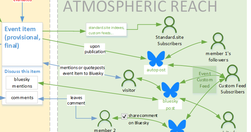
Integrating ATProtocol with your website:lets you build powerful, interactive online communities with very simple code; while giving you in-built reach to 40+m users across the Atmosphere; and allowing your members to own and manage their own data.
experiments.myhub.ai
Integrating your event co-creation community with the Atmosphere brings you increased engagement and improved reach with a substantially simpler website.
greengale.app
"GreenGale is a blogging platform built on AT Protocol:uses Markdown formatting ... WhiteWind compatible... read and write WhiteWind content from GreenGale, and WhiteWind and GreenGale posts are both featured in the feeds and on user profiles...Standard Site is optional ... for cross-platform discoverability... per-account as well as per-post... c…
www.pfrazee.com
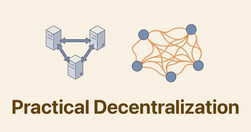
Paul Frazee clearing up confusion surrounding Atproto, ActivityPub and Nostr. The latter two "are good examples of "federated hosts" and "magical meshes," ... Atproto draws inspiration ... but it works like neither".Firstly, though, let's not put the cart before the horse: "The point of decentralization is to guarantee the rights of individuals an…
ngerakines.leaflet.pub
"ATProtocol already supports... Permissioned data ... a love triangle between the user, the identities they grant permissions to, and the applications [which] view controlled data".Nick Gerakines first briefly summarises a previous post setting out how to build permissioned data into atprotocol: adding an optional service field pointing to "a serv…
www.pfrazee.com
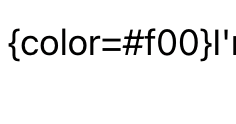
Good explanation from one of Bluesky's engineers about one of the choices they made - to use markdown or to use something called richtext facets?He first sets out the problems with markdown before explaining how rich text facets work:{ text: "Hello @bob.com", facets: [ {feature: "mention", index: {start: 6, end: 14}} ] } "If there's a facet-ty…
isaaccorbrey.com
Another developer reflects on integrating his site with standard.site, finding that Sequoia "handles the core use case reasonably well, but it doesn’t ... support ... multiple publications on a single site", whereas he wants publications for notes (articles and writing), projects (long-lived project writeups) & ramblings.Another issue is that "sit…
experiments.myhub.ai
In case you're not following the development of the Atmosphere yet, I thought I'd share the snowballing energy I see every morning when I open Bluesky’s For You feed.
mosh.leaflet.pub
"the most enduring social networks ... [are] the ones that empower organizers... coaches, teachers, volunteer coordinators, union stewards, event planners, health workers, running club hosts, activist organizers, and owners of community-based businesses ... making decisions on behalf of a group ... turn a collection of individuals into a functi…
blog.joebasser.com
Joe Basser, Spark founder, is also one of the best explainers on the Atmosphere.Building on his previous post, which explains that "When users can leave without losing [everything]... platforms lose the ability to quietly tighten the screws forever", Basser explores what happens as a result: "What does social media look like when anti-enshittifica…
Like
algorithm,
social media,
guide,
interoperability,
bluesky custom feeds,
atprotocol,
standard.site,
coopetition,
joe basser,
spark
bsky.social
In 2026 Bluesky will double down on a feature which gives them "a real advantage... Closed platforms are structurally limited in how they can respond to live moments... one algorithm, one team making decisions, one set of product surfaces, one content policy. An open protocol doesn't have those limits. Anyone can spin up a feed for a live event. A…
unfoldingdiagrams.leaflet.pub
"What makes Bluesky expensive?", asks Jacqueline.not the user data: a "PDS... is little more than a JSON-returning webserver wrapped around a SQLite database. A single PDS on a raspberry pi can host and serve data for tens of thousands of users"nor the relay, which can "run just fine on a raspberry pi... [with] beefy storage drive (a dozen or two …
sequoia.pub

"CLI tool that can take your existing self-hosted blog and publish it to the ATmosphere using Standard.site lexicons... run inside your existing repo, build a one-time config, and then be part of your regular workflow by publishing content or updating existing content ... fully interoperable... if it's a static blog with markdown, Sequoia will wo…
blackskyweb.xyz

"Blacksky Cash ... to let communities that already support one another socially do so materially... raises three essential questions:How do we translate communal, often Indigenous traditions of money-sharing into a heavily regulated financial system?How do we make sharing money online feel meaningful rather than suspicious?How do we frame financia…
overreacted.io
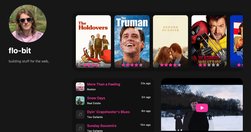
A perfectly brilliant way to introduce AT protocol."What do files have to do with social computing? Historically, not a lot—until recently."Dan first reintroduces files: how they were not originally intended "to live inside the apps... [but] somewhere that you control. Apps create and read your files on your behalf, but files don’t belong to the a…
lab.leaflet.pub
The creators' account of their co-development of, and move to, standard.site, "and how we plan to grow publishing × open social together".Standard.site is "a set of shared standards for longform publishing on the open social web...a set of AT Protocol lexicons for:publication metadata: what a publication is, like its name, description, and basic t…
experiments.myhub.ai
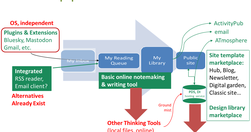
My proposal to the atproto.science conference: "I'm interested in exploring how we can manage competition and cooperation in the atmosphere."
stevedylan.dev
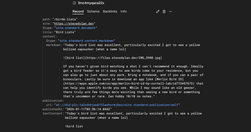
A POSSE-oriented publisher "discovered Standard.site, a new set of lexicons designed especially for publishing ... [with] canonical URLs that point to my site... a journey that significantly boosted my knowledge of ATProto and how Standard.site could be a new gateway for publishing content"It gets a bit technical as he builds his new site using St…
mailchi.mp

"I was in Berlin last November to present at a satellite event around the Summit on European Digital Sovereignty. The two posts which resulted are below, followed by the latest from the growing ATProto4Science movement."
plurality.leaflet.pub
How to study the ATmosphere, which "consists of multiple layers: Layer 4: Social phenomena (communities, discourse, norms) Layer 3: User behavior (posts, follows, moderation) Layer 2: Applications (Bluesky, various clients, Feeds) Layer 1: Protocol (AT Protocol, DID) Layer 0: Infrastructure (servers, networks) Each layer falls under different acad…
skygest.github.io
Good example of ATScience: "Paper Skygest is a personalized research feed that shows posts about papers from accounts in your following network."
standard.site
"Standard.site provides shared lexicons for long-form publishing on AT Protocol. Making content easier to discover, index, and move across the ATmosphere" - by the makers of leaflet, pckt & offprint - a good example of how builders can just collaborate on the ATmosphere without drama: "The standard grows when builders identify shared needs and ali…
Like
open web,
longform,
blog,
collective intelligence,
myhub,
atprotocol,
atprotocol lexicon,
leaflet,
standard.site
www.pfrazee.com
Bluesy's Paul Frazee on where cloud computing went: "the clouds are closed... they'll do everything well except interoperating with others. But there's nothing that says clouds have to be closed. Closed networks are a big company thing, not a cloud thing... We need to bridge our clouds... Atmospheric computing is a paradigm of connected clouds".O…