
Curated Resource ( ? )
A Government Guide to Open Protocols
Curated:
31/03/2026 from
protocolized.summerofprotocols.com/p/a-government-guide-to-open-protocols
my notes ( ? )
Instead of depending on "large proprietary vendors" or building your own, "Open protocols offer a third path. Infrastructure that no single actor owns, that evolves through distributed processes... can be implemented by anyone with the technical capacity... allow governments to reduce dependency on individual vendors without cutting themselves off from global technology ecosystems". Early examples include "Tchap – a secure messaging platform for the French public administration – on Matrix".
There's also "legally mandated interoperability ... Public administrations are expected to build digital services that can function across Member States and integrate into shared European infrastructures."
This means "public institutions [must] treat protocol engagement as a first-class infrastructure responsibility rather than a background technical detail."
But they're not set up for this because of the way they procure technology and services. With IT procurement, "When something breaks, there is someone to call... When an institution procures a system built on an open protocol, it is ... entering a coordination ecosystem governed by rules that will continue to evolve ... through processes that the procurement office did not assess and toward outcomes that no single party controls."
"open protocols replace vendor dependency with ecosystem dependency"
"If the protocol evolves ... practical alternatives are limited", while "Protocol governance is continuous... if institutions are not following those processes, they might only notice the consequence of a particular direction when it urgently impacts them".
The solution is to "develop genuine institutional capacity to understand and track how protocol governance works, and to participate", while understanding they cannot control anything, only influence it.
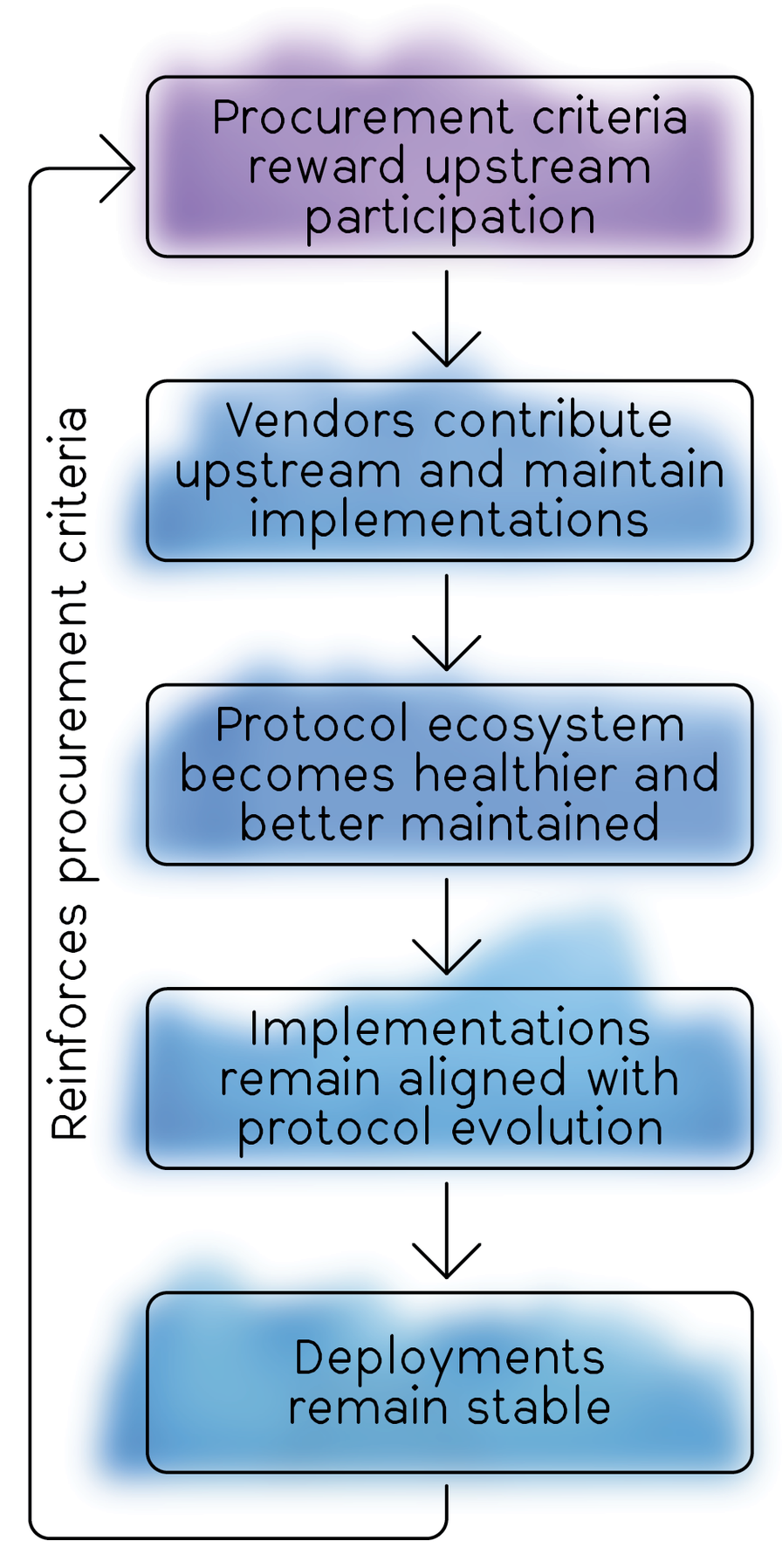
This knowledge does need to be in-house so that "Procurement criteria can then reflect that understanding. Vendors who actively contribute to protocol specifications, participate in security coordination and maintain implementations are better positioned to keep deployments aligned with protocol evolution over time. Procurement frameworks that treat upstream contribution as a resilience signal do not just favour better suppliers. They shift incentives across the whole ecosystem, rewarding vendors embedded in the health of the protocol rather than those treating it as a static dependency."
The author then explores the French adoption of Matrix as an example.
Read the Full Post
The above notes were curated from the full post protocolized.summerofprotocols.com/p/a-government-guide-to-open-protocols.Related reading
More Stuff I Like
More Stuff tagged atproto adoption , atprotocol , matrix , sovereignty
See also: Bluesky and the ATmosphere